

Why Enterprise Agentic AI Requires Deterministic Guardrails
As we navigate the second half of 2026, the initial euphoria surrounding enterprise Large Language Models (LLMs) has given way to a stark engineering reality: Statistical probability is a terrible foundation for mission-critical operations
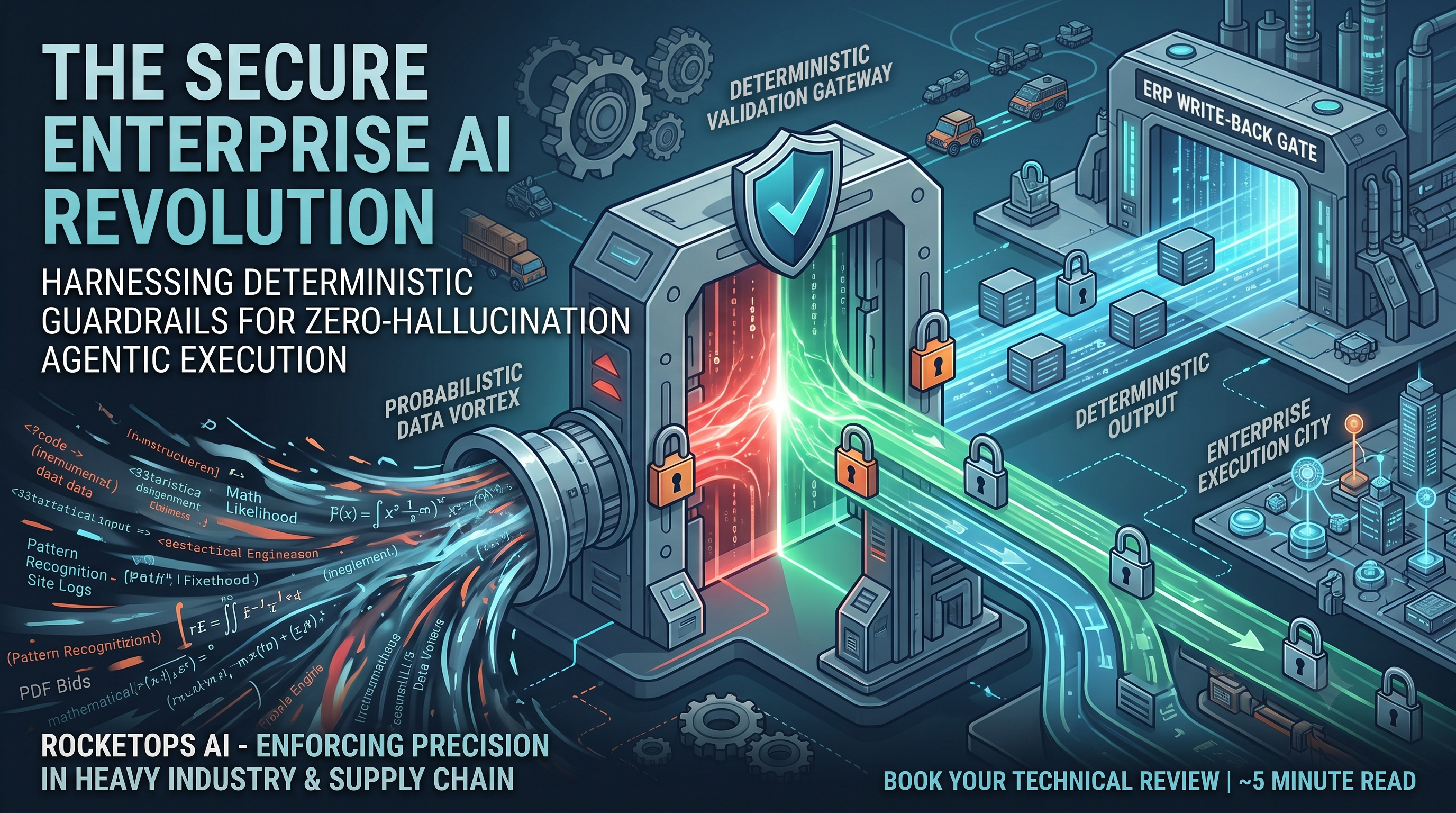
As we navigate the second half of 2026, the initial euphoria surrounding enterprise Large Language Models (LLMs) has given way to a stark engineering reality: Statistical probability is a terrible foundation for mission-critical operations.
For the past two years, enterprise software teams focused heavily on "prompt engineering"—attempting to coerce LLMs into consistent behavior through elaborate system instructions. But as autonomous AI agents move out of sandboxes and into live execution layers (handling procurement, fleet routing, and vendor billing), the limits of pure LLM architectures have become painfully clear.
When an AI model hallucinating a creative twist in a marketing copy is acceptable, but that same model misinterpreting a decimal point on a 10,000-ton structural steel Purchase Order causes a multi-million-dollar operational wreck, probabilistic execution becomes a liability.
To build truly autonomous systems in 2026, tech leaders are moving beyond pure LLMs and adopting Deterministic-Agentic Architecture.
The Core Deficit: Probabilistic vs. Deterministic Systems
To understand why pure AI agents fail in heavy industry, you have to look at the underlying mathematics:
-
Probabilistic Systems (LLMs): Designed to predict the most mathematically likely next token based on training data. They excel at pattern recognition, translation, and parsing unstructured text, but they lack true logical validation.
-
Deterministic Systems (Traditional Code): Executed via hard math, business rules, and explicit logic. Given input $A$, output $B$ is guaranteed 100% of the time with zero variation.
When enterprise developers rely solely on an LLM to parse a complex Bill of Quantities (BOQ) and directly write the results into a database like SAP or Oracle, they are running an unvalidated statistical engine directly against their core balance sheet.
A single hallucinated unit of measurement or incorrect vendor discount code corrupts master records instantly.
The Solution: The Two-Tier Execution Model
At RocketOps AI, we solve this through a strict separation of concerns. Production-grade execution requires treating the LLM as a parser, never as the ultimate decision-maker.
Here is how a Deterministic-Agentic Architecture executes complex industrial workflows without hallucinations:
1. The Probabilistic Parsing Layer
Unstructured data—like messy PDF supplier quotes, hand-scanned delivery notes, or site voice logs—is ingested by fine-tuned LLMs. The model's sole job is to extract raw entities (item names, quantities, unit prices) and convert them into structured JSON schemas.
2. The Deterministic Guardrail Layer
Before any extracted data touches a database or triggers an external API call, it must pass through hard-coded logic validation engines:
-
Mathematical Proofing: Does $\text{Quantity} \times \text{Unit Price}$ equal the quoted total down to the exact cent?
-
Boundary Enforcement: Does the proposed expenditure exceed pre-set spending caps or project margin tolerances?
-
Compliance Verification: Is the selected subcontractor fully cleared against active local safety and legal registries?
If the probabilistic parser outputs data that violates even one deterministic rule, the execution engine halts the process instantly, flagging the exact anomaly for human review.
The LLM is given no authority to override business logic.
Implementing Zero-Hallucination Guardrails in Production
Building this hybrid architecture requires three foundational engineering controls:
-
Structured Output Enforcers: Enforcing strict schemas (like Pydantic or JSON Schema) at the API level so the model physically cannot return improperly structured types or missing fields.
-
Stateful Validation Gateways: Intercepting every tool call or database write-back using deterministic middleware that validates arguments against live ERP state variables.
-
Sovereign Execution Runtime: Running both the parsing models and the logic enforcers entirely on-premise or within isolated, private cloud environments—guaranteeing complete data residency and zero external data leaks.
How RocketOps AI Architected Zero-Hallucination Execution
We built our enterprise product suite specifically to give heavy industrial operators the speed of AI with the certainty of deterministic software:
-
The Concrete Engine: Our sovereign AI Operating System uses a dual-engine core—combining air-gapped local LLMs for parsing with deterministic guardrails for execution—ensuring zero hallucinations touch your core ERP.
-
BuildOS: Normalizes unstructured construction documents and BOQs into validated, schema-strict data layers that agents can process with total mathematical precision.
-
FuelTrack Pro: Applies deterministic fleet tracking logic and margin checks directly to automated logistics routing in the field.
Stop Trusting Probabilities. Enforce Precision.
The future of enterprise software is not about building bigger prompts or hoping an AI model "behaves." It is about engineering deterministic wrapper layers that harness AI intelligence while enforcing absolute mathematical control.
If your enterprise automation strategy relies on unvalidated AI outputs, you are operating on borrowed time.
Build an unbreakable execution layer.
The engineering team at RocketOps AI is currently conducting 15-Minute T+0 Architecture Scoping Sessions for technical leaders and enterprise operators. We will audit your current automation workflows, evaluate your system guardrails, and show you how to deploy a sovereign, zero-hallucination execution engine behind your firewall.


