The Integration Myth: Why Connecting Your Construction Software Stack Won't Save Your Margins
GCC construction companies spend millions integrating SAP, Oracle, and Procore via APIs. Learn why data integration is a trap and why autonomous AI execution is the only way to stop cost overruns.
If you look at the digital transformation strategy of almost any major GCC construction enterprise in 2026, you will find the exact same multi-million dollar mistake.
It is called the "Integration Strategy."
For the last five years, IT consultants have sold construction executives on the dream of the "unified dashboard." The pitch is simple: if we just buy enough APIs to connect your SAP ERP to your Primavera scheduling tool, and link that to your Procore site management app, all your operational bottlenecks will disappear.
This is a complete myth.
Connecting your construction software stack does not solve construction cost overruns. It just gives you a faster, more expensive way to watch your project margins bleed. Here is why the API integration era is dead, and why GCC industrial leaders are abandoning it for autonomous AI execution layers.
The API Trap: Moving Data is Not Executing Work
The fatal flaw of construction software integration in the UAE and wider GCC is that it confuses data movement with workflow execution.
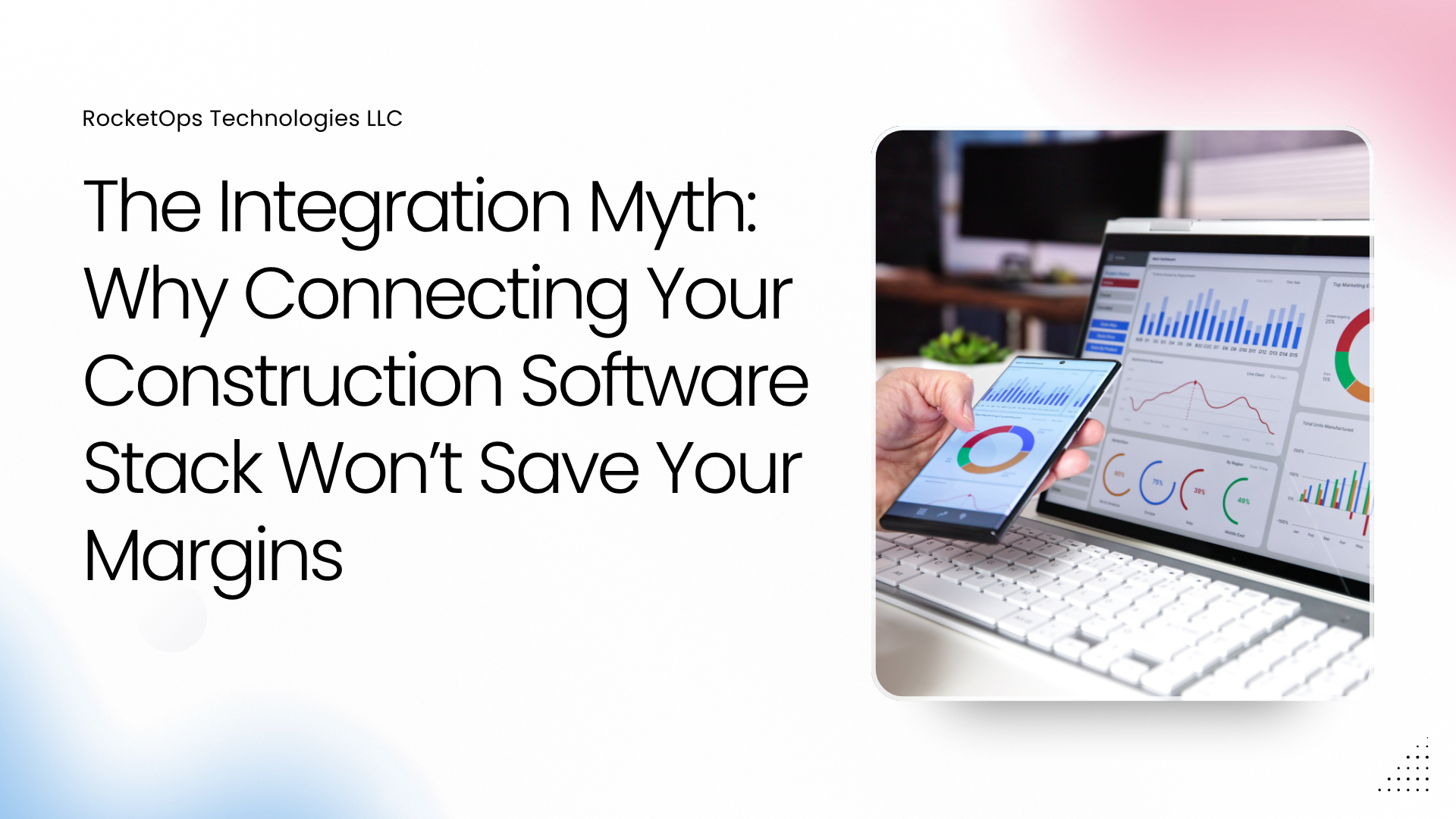
Let’s say a severe weather event delays your heavy machinery logistics by 48 hours. In a perfectly "integrated" tech stack, the weather app pings the logistics software, which pings your SAP ERP, which updates the master schedule dashboard.
Congratulations. You now have a highly integrated, real-time dashboard glowing red.
But the system hasn't actually done anything to fix the problem.
The software simply moved the bad news from one server to another. To prevent a catastrophic schedule delay, a human project manager still has to sit down, review the red dashboard, log into three different platforms, manually cancel the concrete pour, draft an email to the subcontractors, and rebook the crane operators for Thursday.
Integration gave you visibility. It did absolutely nothing to close the Execution Gap.
The "Swivel Chair" Operator
When enterprise tech stacks are integrated but not autonomous, your highest-paid employees become the real APIs.
We call this the "Swivel Chair Operator." You are paying senior procurement directors and head project engineers to swivel back and forth between screens, reading data on monitor A and manually executing the resulting workflow on monitor B.
This manual execution latency is the true root cause of enterprise construction failures. When project pivots rely on human keystrokes, decisions take days instead of milliseconds. In heavy industry, time is capital. Every hour an engineer spends doing data entry to reroute a supply chain is an hour the project is bleeding margin.
The Solution: From Integration to Autonomous Execution
To actually solve the execution gap, you don't need another API connecting two passive databases. You need an active intelligence layer that executes the work for you.
This is exactly why GCC mega-projects are adopting the AI Operating System (AI OS) model.
An on-premise AI OS, like the RocketOps Concrete Engine, does not replace your legacy SAP or Oracle database; it sits on top of it. Instead of merely moving data around, the AI OS deploys specialized, autonomous agents that act on that data.
When that same weather delay hits, the AI OS doesn't just update a dashboard. It executes:
-
Ingestion: It detects the 48-hour delay in the master logistics feed.
-
Cross-Referencing: The AI agent instantly checks subcontractor availability and equipment lease agreements.
-
Autonomous Execution: It autonomously cancels the scheduled concrete delivery, pushes the crane rental agreement by two days, and drafts a rescheduled PO for human approval—all in under two seconds.
The integration era connected your apps. The AI OS era clicks the buttons inside them.
Data Sovereignty: The On-Premise Imperative
Why hasn't standard AI solved this yet? Because generic, public-cloud AI models are a massive security liability.
You cannot feed sensitive GCC construction blueprints, negotiated subcontractor pricing, and critical path logistics into a public LLM. True enterprise AI construction workflows require Data Sovereignty.
An enterprise-grade AI OS operates strictly on-premise or within an air-gapped environment. The autonomous agents execute their routing, planning, and procurement tasks 100% behind your corporate firewall. You get the unprecedented speed of machine-level execution without exposing a single byte of corporate intelligence to the public cloud.
The Bottom Line
Stop paying consultants millions of dollars to build you a better dashboard. Your operators do not need more visibility into the problems; they need software that actively executes the solutions.
By replacing passive integrations with an active, on-premise AI Operating System, construction enterprises are eliminating the swivel-chair operator, closing the execution gap, and finally securing their margins.
Frequently Asked Questions (FAQ)
1. Why is software integration no longer enough for GCC construction? Software integration (via APIs) only moves data between apps to update dashboards. It still relies entirely on human operators to read that data and manually execute the necessary changes, which creates costly operational delays.
2. How does an AI OS differ from a standard API integration? An API connects databases so they can share information. An AI OS is an autonomous execution layer that acts on that information. It can autonomously make decisions, draft emails, update schedules, and issue POs based on pre-set business logic.
3. Does deploying an AI OS mean we lose control over our operations? No. An AI OS operates on deterministic, rule-bound logic. It executes repetitive, tactical workflows (like supply chain rerouting or RFQ generation) automatically, but high-level financial approvals and strategic decisions always remain in the hands of human directors.
4. Will we need to replace our current SAP, Oracle, or Procore systems? No. An AI OS is designed to sit on top of your existing tech stack. It uses your legacy ERP as the underlying system of record, acting as the intelligent "brain" that drives the manual processes your humans used to do.
5. How does an on-premise AI OS protect our proprietary construction data? Unlike cloud-based AI tools (like ChatGPT) that send data to external servers, an on-premise AI OS is hosted locally behind your company's firewall. 100% of your operational data, pricing, and blueprints remain entirely secure and sovereign.


