Why Legacy ERP Fails Industrial Operations in the GCC (And What Replaces It)
For decades, industrial leaders in construction, logistics, and manufacturing have poured millions into systems like SAP, Oracle, and Microsoft Dynamics.
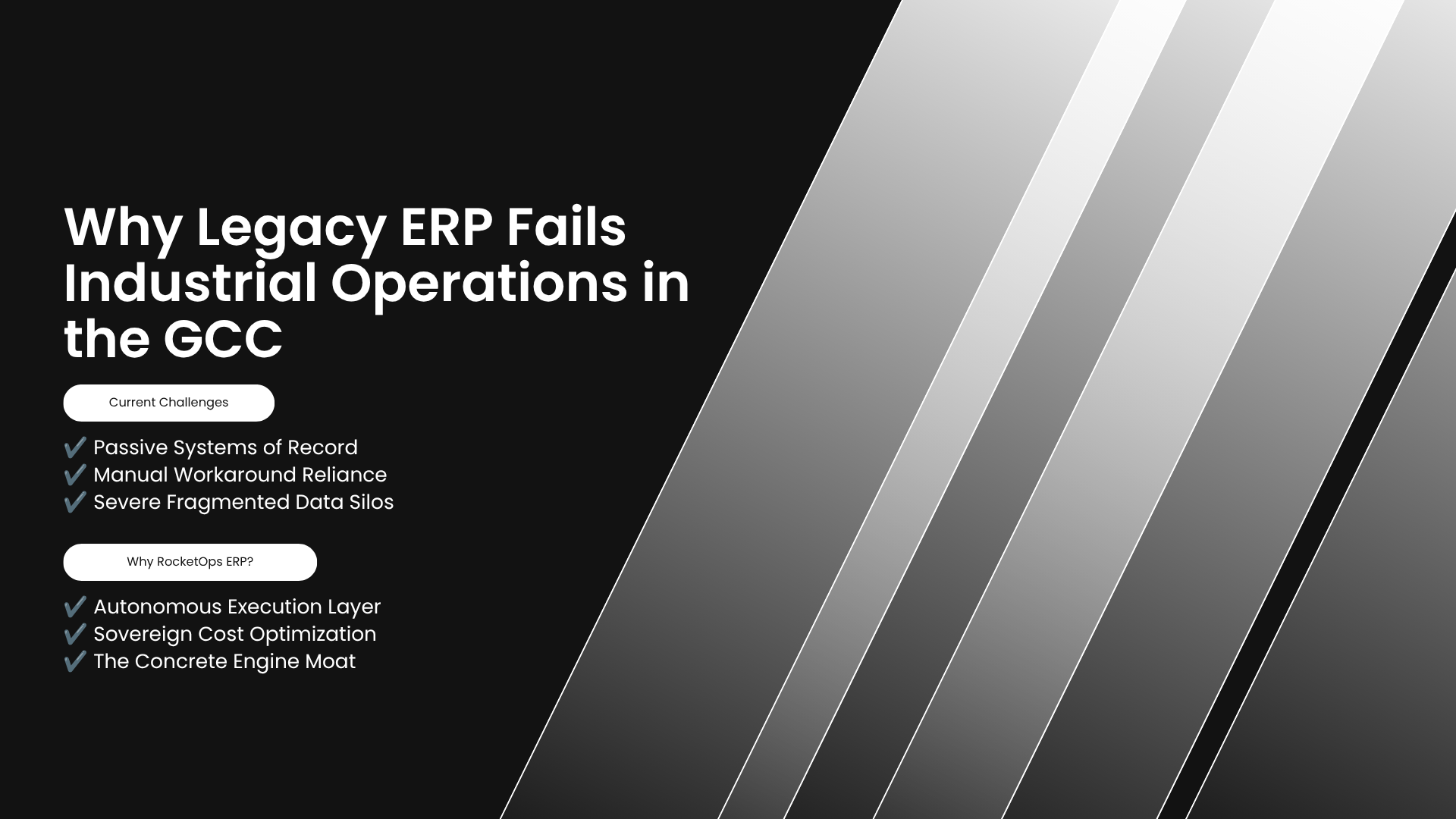
The Gulf Cooperation Council (GCC) is currently executing some of the most ambitious industrial and infrastructure projects in human history. From mega-cities in Saudi Arabia to expanding manufacturing hubs in the UAE, the scale of operations is unprecedented. Yet, behind the multi-billion-dollar budgets and aggressive timelines, a silent crisis is bleeding margins: the failure of legacy Enterprise Resource Planning (ERP) systems.
For decades, industrial leaders in construction, logistics, and manufacturing have poured millions into systems like SAP, Oracle, and Microsoft Dynamics. The promise was total operational control. The reality is a fractured ecosystem of disconnected dashboards, manual data entry, and reactive decision-making.
In this comprehensive guide, we dissect why traditional ERP systems are failing heavy industries in the GCC, the massive financial impact of the "Execution Gap," and why autonomous AI Operating Systems are rapidly replacing passive software.
The "Execution Gap": Why Dashboards Are Not Enough
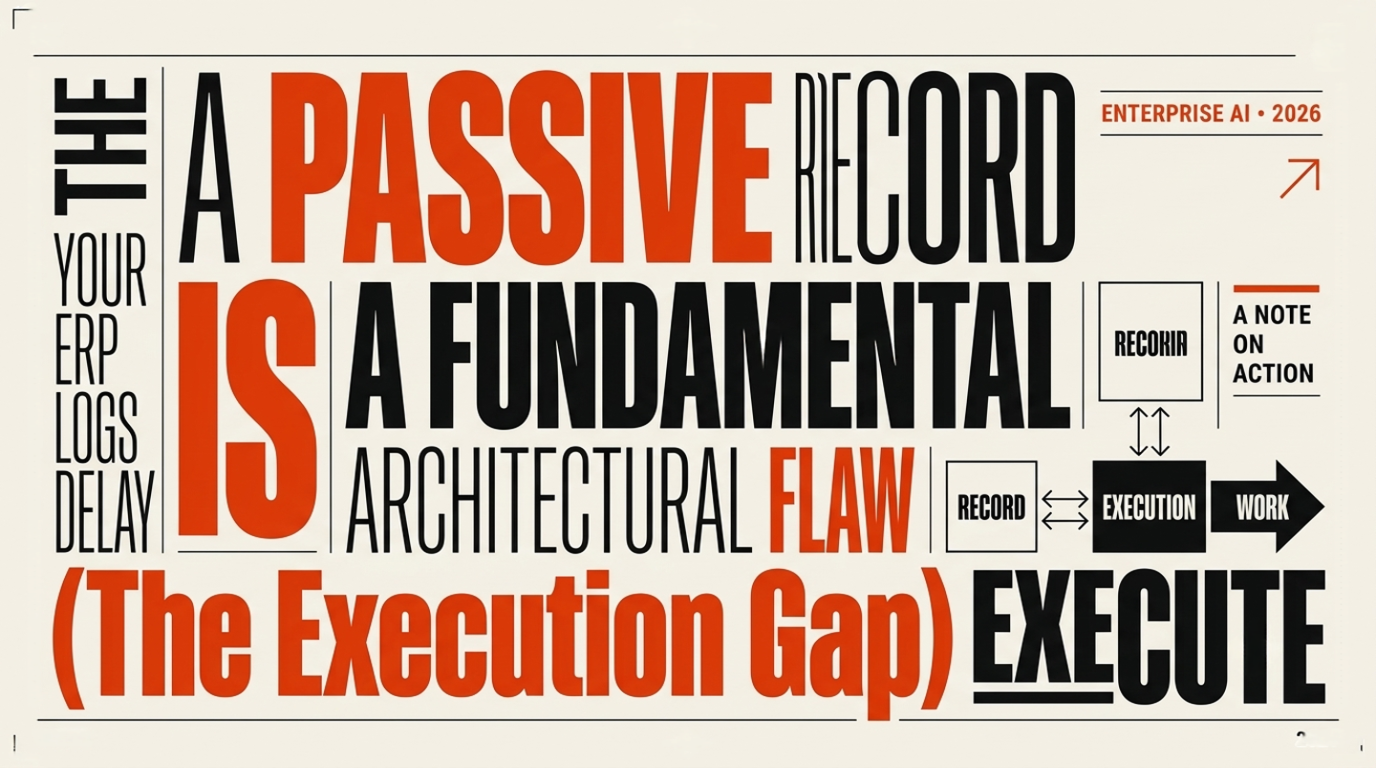
In a rapidly scaling precast factory or a sprawling heavy logistics network, speed is the ultimate currency. The fundamental flaw of a legacy ERP is that it is a passive system of record.
ERPs are essentially expensive history books. They require humans to input data, and in return, they generate reports that tell you what happened yesterday. If a critical raw material shipment is delayed, or a piece of heavy machinery goes offline, the ERP will update a dashboard. However, a dashboard cannot re-route a fleet, negotiate a new purchase order, or adjust a production schedule. It merely highlights the crash; it does not steer the car.
This creates the Execution Gap—the lethal latency between when a system registers a problem and when a human operator actually executes a solution. In modern GCC industrial operations, 73% of critical decisions are made after the operational window to fix the problem has closed.
To bridge this gap, teams inevitably revert to manual workarounds. You end up with a million-dollar ERP system, yet the actual daily execution of the business is run on WhatsApp groups, disorganized spreadsheets, and frantic phone calls.
By The Numbers: The Reality of ERP Implementations
The data surrounding legacy ERP deployments in the industrial sector is staggering. According to recent industry analyses, traditional ERP implementations are fraught with systemic failures:
-
Massive Failure Rates: More than 60% to 70% of ERP implementations fail to meet their original objectives, resulting in weak adoption and an inability to deliver expected ROI.
-
Crippling Cost Overruns: ERP projects frequently exceed their planned budgets, with cost overruns commonly reaching 50% to 200% of the original estimates. In discrete manufacturing, average cost overruns can hit a devastating 215%.
-
Timeline Delays: On average, ERP deployments take 20% to 40% longer than expected, often dragging out for 15 to 18 months.
-
Underutilization: Approximately 25% to 30% of configured ERP capabilities go entirely unused after implementation due to clunky workflows and poor user adoption.
These failures are not due to bad software; they are due to a fundamentally outdated architecture that forces dynamic, high-speed industrial businesses to conform to rigid, manual data structures.
The 3 Fatal Flaws of Traditional ERPs in Heavy Industry
To understand why a new paradigm is required, we must examine exactly where standard ERPs break down when applied to GCC construction, manufacturing, and logistics.
1. Inability to Handle Shop-Floor and Site Reality
Generic ERP systems struggle to track work-in-progress in real-time, forcing teams to rely on manual updates. In construction, standard accounting modules cannot handle the nuances of dynamic job costing, multi-level bills of materials (BOMs), or rapid contract shifts. When the system does not reflect the physical reality of the site, operators abandon it.
2. The Illusion of Integration
Mid-sized and enterprise companies often rely on a patchwork of tools: CRM, eCommerce, PLM, and third-party logistics systems. Legacy ERP architectures are notoriously rigid. When new departments or product lines are added, integrating these systems becomes technically complex, leading to data silos, duplicated efforts, and massive integration bottlenecks.
3. Passive Analytics vs. Active Execution
When a supply chain anomaly occurs—such as a delayed shipping manifest—a traditional ERP will simply alert a human user. The human must then log in, analyze the data, manually find an alternative supplier, draft an RFQ, wait for approval, and issue a PO. This manual loop takes days. The ERP identifies the bottleneck but does absolutely nothing to eliminate it.
The Paradigm Shift: ERP vs. AI Operating Systems
The era of passive software is ending. In 2026, the most competitive GCC enterprises are abandoning traditional ERP expansion in favor of Autonomous AI Operating Systems.
Instead of adding more dashboards, an AI Operating System acts as an active execution layer that sits on top of your existing infrastructure. It does not just record data; it executes the workflow.
| Feature | Legacy ERP | Autonomous AI OS (e.g., RocketOps) |
| Core Function | Passive Record-Keeping | Active Decision Execution |
| Human Requirement | High (Heavy manual data entry) | Zero to Low (Agents run autonomously) |
| Speed to Action | Hours to Days | Milliseconds |
| System Architecture | Rigid, fragmented modules | Unified Command Center |
| Workflow Automation | Triggers alerts | Issues POs, routes fleets, adjusts schedules |
Systems like RocketOps deploy specialized AI Agents (such as PROCUREMENT.AGENT or LOGISTICS.AGENT) that run 24/7. When a delay is detected, the AI does not just flag it—it instantly analyzes vendor contracts, issues a new RFQ, and re-routes dispatch schedules without requiring human intervention. This shift from recording to executing routinely results in an 8.2x acceleration in operational cycles and a massive reduction in project costs.
The Sovereign Data Mandate: On-Premise AI for the GCC
One of the largest hurdles to adopting enterprise AI in the Gulf region is data sovereignty. Defense-adjacent manufacturers, government-linked construction mega-projects, and critical logistics networks cannot afford to send proprietary bills of materials, financial data, or supplier pricing to public LLMs hosted on foreign servers.
This is where traditional cloud-based SaaS tools fail the enterprise test. To safely deploy an AI Operating System, the architecture must be air-gapped.
Advanced platforms like the RocketOps Concrete Engine solve this by running 100% on-premise AI inference. There is zero data egress. Every token, every prompt, and every purchase order remains sealed entirely within the organizational perimeter. This allows GCC enterprises to achieve massive autonomous automation while maintaining total compliance with regional data residency laws and strict ISO 27001 security standards.
Conclusion: The End of the Dashboard Era
The operational bottlenecks plaguing GCC industrial firms will not be solved by buying another software module or hiring more consultants to fix a broken SAP implementation. The future belongs to businesses that replace manual execution with autonomous AI workforces.
If your current ERP only tells you what happened yesterday, it is time to upgrade to an Operating System that controls what happens today.